We use essential cookies to make this site work. With your permission, we also use optional cookies to improve and personalise your experience, including cookies from third parties.
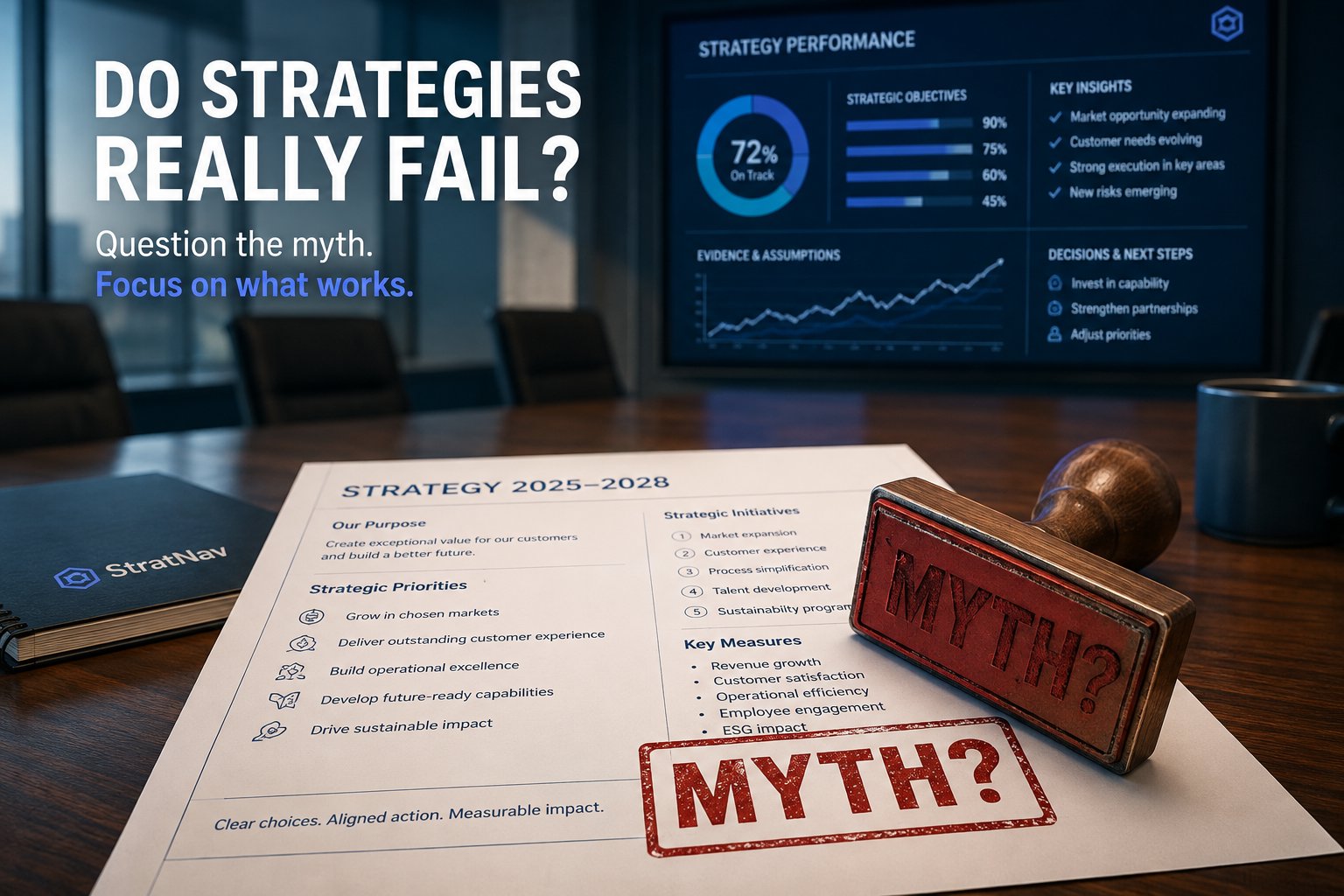
It's one of the most quoted statistics in business. It appears in keynote presentations, board papers and consulting proposals around the world. It has shaped how organisations think about strategy execution for decades.
There's just one problem.
No one really knows whether it's true.
That isn't a trivial academic point. If we've built our understanding of strategy execution on an unsupported statistic, we may have spent years solving the wrong problem.
The better question isn't, "Why do strategies fail?"
It's, "What actually prevents organisations from turning good strategic thinking into better business performance?"
The answer is both more nuanced and far more useful.
The myth that shaped a generation
The familiar claim that 50–90% of strategies fail has become accepted wisdom. Yet when researchers Carlos Cândido and Sérgio Santos reviewed the evidence behind these widely quoted estimates, they reached a striking conclusion.
The true rate of strategy implementation failure remains unknown. Many of the commonly cited figures are based on evidence that is "outdated, fragmentary, fragile or just absent." They caution against using these numbers to justify changes in management theory or practice.
That should give every executive pause.
Evidence matters. If we expect our own strategic decisions to be grounded in reliable evidence, we should apply the same standard to the management ideas we adopt.
The real issue isn't execution alone
If we set aside the folklore, a different picture begins to emerge.
Recent research from McKinsey suggests that only 21% of executives believe their organisation's strategy would pass four or more of its ten tests of a good strategy. Fifteen years earlier, that figure was 35%.
In other words, strategy quality appears to have declined significantly.
This changes the conversation completely.
Poor execution certainly exists. But no amount of disciplined execution can compensate for a strategy built on weak assumptions, superficial insights or unclear choices.
A poor strategy executed perfectly is still unlikely to produce exceptional results.
Execution starts long before implementation
Many organisations think of strategy as a sequence:
Analyse the market.
Develop the strategy.
Communicate it.
Execute it.
Review performance.
It looks neat. Unfortunately, organisations rarely behave so neatly.
Strategy is not a document that moves through a production line. It is a continuous process of learning, choosing, communicating, coordinating and adapting.
By the time an organisation reaches what it calls "execution", many of the factors determining success have already been established.
For example:
Was the strategy built on genuine evidence or assumptions?
Were difficult choices made, or were competing priorities left unresolved?
Do leaders share a common understanding of what success looks like?
Have people across different functions understood not just what to do, but why it matters?
Does the adapt when new evidence comes to light?
These questions cannot be solved by another project plan.
The missing capability: mobilisation
One of the most interesting developments in recent strategy research is the growing emphasis on mobilisation.
Mobilisation sits between strategy formulation and execution.
It is the work of helping an organisation understand, align around and commit to strategic choices before expecting results to follow.
This involves:
building shared understanding
testing assumptions
coordinating across functions
linking initiatives to strategic objectives
maintaining momentum through regular review
Many organisations underestimate this phase.
They assume that once the strategy has been approved and communicated, implementation naturally follows.
Experience suggests otherwise.
Better strategies are living systems
Traditional strategy processes often assume a stable environment.
Develop a three-year plan.
Communicate it.
Measure progress.
Repeat annually.
Today's organisations operate in a world shaped by AI, geopolitical uncertainty, changing customer expectations and rapid technological change.
Static strategy documents struggle to keep pace.
Successful organisations increasingly treat strategy as a living system rather than a fixed plan.
That means continuously asking questions such as:
What has changed?
Which assumptions still hold?
What evidence has emerged?
Which priorities need adjusting?
What have we learned?
Reviewing strategy becomes less about reporting progress and more about improving decisions.
Technology should support thinking—not replace it
Many organisations still manage strategy through disconnected PowerPoint presentations, spreadsheets and meeting notes.
These tools are useful, but they were never designed to support collaborative strategic decision-making.
But execution is only one capability within a much broader discipline of strategic management.
The organisations that outperform their competitors are unlikely to be those with the most detailed implementation plans.
They will be the ones that make better strategic decisions—and keep improving them as the world changes.
Call to action
If you're looking to move beyond static strategy documents and create a more collaborative, evidence-based approach to strategic management, explore how StratNav can help you develop, communicate and continuously improve your strategy.
Or, if you'd like to discuss how your organisation can strengthen its strategic capabilities, book a conversation with Chris C Fox Consulting Limited.
The true strategy implementation failure rate is unknown. Researchers have found that widely quoted failure rates of 50–90% are often based on evidence that is outdated, fragmentary, fragile or absent.
Why do strategies fail?
Strategies can produce poor results because of weak assumptions, superficial insights, unresolved priorities, unclear choices, limited organisational alignment and inadequate adaptation. Poor execution is only one possible cause.
Can good execution compensate for a poor strategy?
No. Disciplined execution cannot compensate for a strategy founded on weak assumptions, superficial insights or unclear choices. A poor strategy executed perfectly is still unlikely to produce exceptional results.
When does strategy execution begin?
Strategy execution begins long before formal implementation. The evidence used, choices made, priorities resolved, shared understanding created and ability to adapt all influence whether a strategy will deliver better performance.
What is mobilisation in strategy?
Mobilisation is the work between strategy formulation and execution that helps an organisation understand, align around and commit to its strategic choices. It includes testing assumptions, coordinating functions, linking initiatives to objectives and maintaining momentum.
What does it mean to treat strategy as a living system?
Treating strategy as a living system means reviewing and adapting it continuously rather than relying on a fixed annual plan. Organisations regularly examine what has changed, which assumptions still hold, what they have learnt and whether priorities need adjusting.
How can technology support strategic management?
Strategy technology can connect evidence to insights, record assumptions, align objectives with initiatives and measures, improve visibility across teams and support regular review. It cannot create a good strategy, but it can help organisations develop, communicate and improve one.
What questions should leaders ask about their strategy?
Leaders should ask whether the strategy is based on robust evidence, whether genuine strategic choices have been made, whether priorities are widely understood, whether functions are coordinating effectively and whether key assumptions are still valid.
About the author
Chris C Fox is an independent business strategy consultant and founder of StratNav. He helps consultants scale their impact, supports C-suite leaders in executing enterprise-wide strategies, and equips founders to grow and adapt with confidence.
👉 Learn more about Chris and his work.
👉 Book a strategy call or try StratNav for free.
Share this on:
LinkedInTwitterFacebookEmail
Every time you share anything about StratNav with someone else, you help them to develop and execute better business strategies, and you help to support us and our ability to continue to make the platform even better for you. So it really is a win-win!