Why Strategy Fails in Meetings, Not Markets
4 min read
Strategy fails in meetings, not markets. Discover why most meetings lack real commitments—and how StratNav turns talk into traction.
Contents
- What Fernando Flores noticed that most leaders miss
- What’s wrong with most strategy meetings?
- What’s the difference between talking about action and creating it?
- How does StratNav turn talk into traction?
- 1. Why move the thinking out of the meeting?
- 2. What if you opened meetings with a decision list?
- 3. Why surface breakdowns instead of hiding them?
- 4. How do you turn a discussion into a request?
- 5. Why is a request meaningless without a response?
- 6. What does “done” look like?
- 7. Why read commitments out loud?
- 8. Where does real execution happen?
- What’s the uncomfortable truth about strategy failure?
- What’s the one-question test of your last meeting?
- Want strategy meetings that lead to real change?
Contents · 15 sections
- What Fernando Flores noticed that most leaders miss
- What’s wrong with most strategy meetings?
- What’s the difference between talking about action and creating it?
- How does StratNav turn talk into traction?
- 1. Why move the thinking out of the meeting?
- 2. What if you opened meetings with a decision list?
- 3. Why surface breakdowns instead of hiding them?
- 4. How do you turn a discussion into a request?
- 5. Why is a request meaningless without a response?
- 6. What does “done” look like?
- 7. Why read commitments out loud?
- 8. Where does real execution happen?
- What’s the uncomfortable truth about strategy failure?
- What’s the one-question test of your last meeting?
- Want strategy meetings that lead to real change?
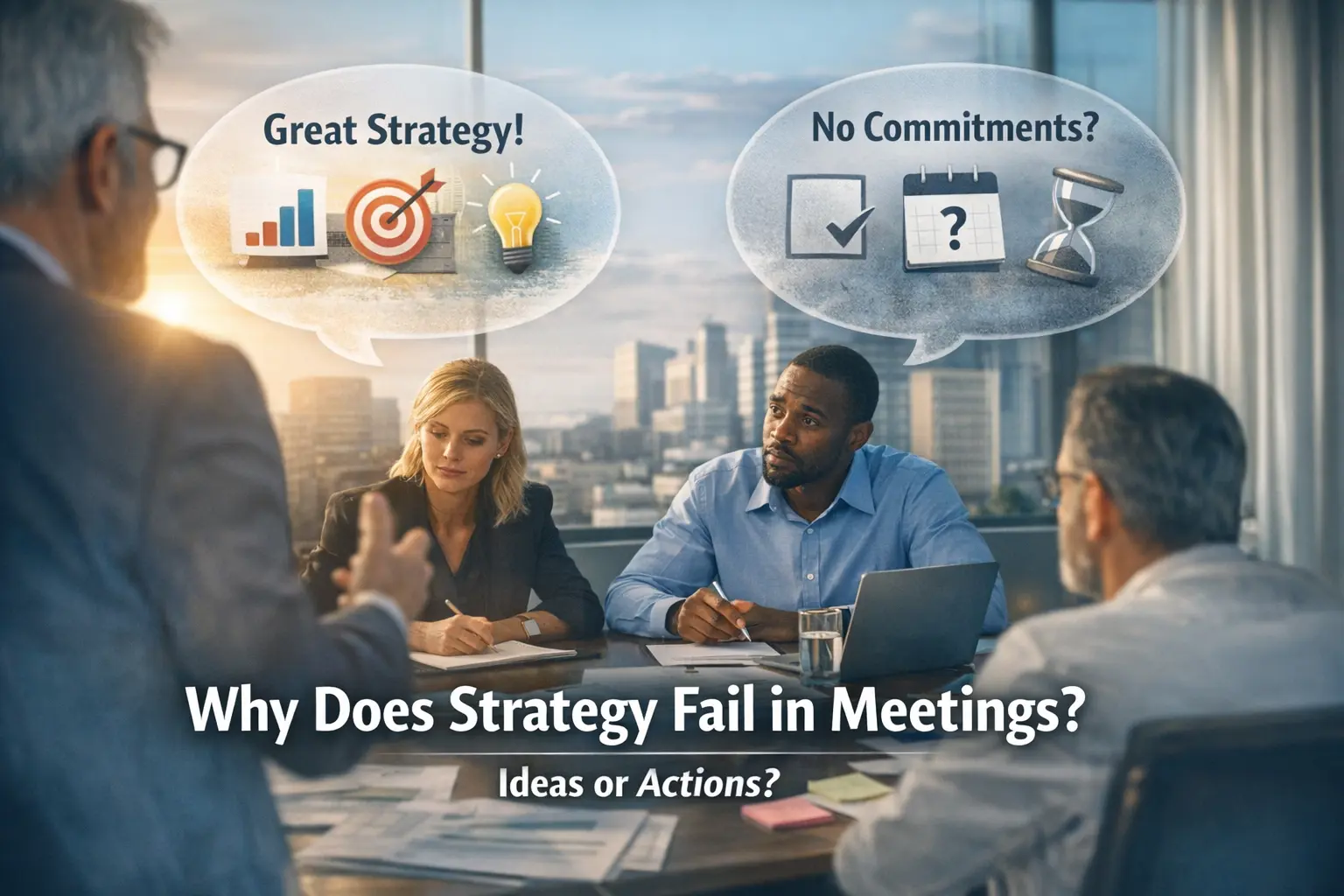
They're built on solid logic, backed by good data, and created by smart people.
So why do they so often fail?
The market? The customer? Bad timing?
These are comfortable scapegoats.
But the real breakdown often starts somewhere far more mundane—in the meeting room.
What Fernando Flores noticed that most leaders miss
Why don't ideas lead to action?
Philosopher and management thinker Fernando Flores observed something profound:
Organisations don’t fail due to a lack of ideas.
They fail because their meetings don’t produce commitments.
Think about that.
Your strategy didn’t fail in the marketplace.
It failed when a meeting ended without anyone making or recording a promise.
What is the role language plays in execution?
Flores argued that organisations act through language.
❌ Not slides.
❌ Not plans.
❌ Not roadmaps.
Just conversations—and the promises made within them.
What’s wrong with most strategy meetings?
Are your meetings full of talk but no traction?
Most strategy meetings include:
-
Thoughtful analysis
-
Energetic debate
-
Agreement “in principle”
But they often lack:
-
Explicit requests
-
Named owners
-
Clear deadlines
-
Shared understanding of outcomes
So although everyone nods, nothing actually changes.
What’s the difference between talking about action and creating it?
What does talk about action sound like?
“We need better execution.”
“Let’s prioritise customer success.”
“Growth is the focus.”
This is abstract. Strategic-sounding.
But it leaves no trace.
No one is on the hook.
What does talk that creates action sound like?
“Can you redesign the onboarding process by next Friday?”
“Yes, I’ll take that on.”
“Success looks like a 20% drop in churn.”
These are real commitments.
They change what happens next.
How does StratNav turn talk into traction?
StratNav is purpose-built to bridge the gap between strategic conversation and execution.
It doesn’t just document ideas.
It drives decisions, requests, and promises.
Here’s how.
1. Why move the thinking out of the meeting?
Because meetings should focus on decisions, not downloads.
In StratNav, you can prepare in advance:
-
Insights
-
Risks
-
Assumptions
-
Strategic options
This clears the decks so your meeting is about what next, not what now.
2. What if you opened meetings with a decision list?
Try this:
“What 1–3 commitments must we walk out with today?”
If it’s not a decision, consider leaving it off the agenda.
StratNav helps you track and limit meeting focus to what really matters.
3. Why surface breakdowns instead of hiding them?
Strategic meetings should start with:
-
What’s not working?
-
What are we worried about?
-
What assumptions might be wrong?
In StratNav, you log these directly against your initiatives—so problems don’t disappear into small talk.
4. How do you turn a discussion into a request?
This is the turning point.
Ask:
-
Who will do what?
-
By when?
-
For what purpose?
In StratNav, these become structured requests—not vague “next steps.”
5. Why is a request meaningless without a response?
Every request needs a reply:
-
“Yes, I’ll do it.”
-
“No, I can’t.”
-
“Here’s what I can do.”
StratNav captures:
-
The owner
-
The deadline
-
The scope
Because silence isn’t commitment.
6. What does “done” look like?
This is where execution often fails.
Every commitment in StratNav must include:
-
Success criteria
-
Expected output
-
The decision it supports
This reduces ambiguity and rework.
7. Why read commitments out loud?
Before the meeting ends, say:
“Let’s review: Who committed to what, and by when?”
StratNav treats this as the true output of the meeting.
No commitment = no progress.
8. Where does real execution happen?
Between meetings.
That’s where StratNav shines:
-
Tracks progress
-
Flags slippage
-
Replaces status meetings with real-time trust
What’s the uncomfortable truth about strategy failure?
It’s rarely about:
-
Intelligence
-
Insight
-
Effort
It’s more often about:
-
Vague conversations
-
Unmade requests
-
Weak follow-through
Markets don’t create these problems.
They simply reveal them.
What’s the one-question test of your last meeting?
Ask yourself:
“What new promises exist now that didn’t exist before this meeting?”
If the answer is “none,”
you didn’t hold a strategy meeting.
You held a discussion.
StratNav exists to make that distinction impossible to ignore.
Want strategy meetings that lead to real change?
🎯 Try StratNavApp.com yourself for free
📅 Schedule a demo
💬 Or book a call to explore how to transform your strategy process.
See also:
- The Power of Strategy: Unleashing Growth Through Effective Meetings
- Using Meetings in StratNav
- How to run effective Strategy Meetings
- Empower your strategy meetings with automatic AI transcripts
- Plan you strategy meetings with StratNav's AI Agenda Writer
